MB-820全真模擬試験、MB-820最新知識
Wiki Article
さらに、CertJuken MB-820ダンプの一部が現在無料で提供されています:https://drive.google.com/open?id=1y87DurNvr_oMv78YEZynyVxZMxYS_mm-
我々CertJukenのMB-820問題集はあなたの発展に大助けを提供することができます。MB-820試験に合格したら、あなたがより良く就職し輝かしい未来を持っています。この試験が非常に困難ですが、実は試験を準備するとき、もっと楽になることができます。我々のMicrosoftのMB-820問題集を利用してから、あなたは短い時間でリラクスで試験に合格することができます。
Microsoft MB-820 認定試験の出題範囲:
| トピック | 出題範囲 |
|---|---|
| トピック 1 |
|
| トピック 2 |
|
| トピック 3 |
|
| トピック 4 |
|
MicrosoftのMB-820認定試験に楽に受かるコツが何だろう
多くの大学生、多くの労働者、さらに多くの主婦など、MB-820試験に合格するために最善を尽くす人が増えています。 MB-820試験に合格したいこれらの人々は、試験を自分自身を向上させ、大きな進歩を遂げる唯一の機会と考えています。そのため、彼らはMB-820試験の準備に全力を尽くすことを望んでいますが、多くの人が重要なMB-820試験の準備に十分な時間がないことは明らかです。 MB-820試験の質問は、最小限の時間と労力でMB-820試験に合格するのに役立ちます。
Microsoft Dynamics 365 Business Central Developer 認定 MB-820 試験問題 (Q86-Q91):
質問 # 86
You are developing an app that will be published to Microsoft AppSource.
The app requires code analyzers to enforce some rules. You plan to add the analyzers to the settings.json file.
You need to activate the analyzers for the project.
Which three code analyzers should you activate to develop the app for AppSource? Each correct answer presents part of the solution NOTE: Each correct selection is worth one point.
- A. a custom rule set
- B. PerTenantExtensionCop
- C. AppSourceCop
- D. UlCop
- E. CodeCop
正解:B、C、D
解説:
When developing an app for Microsoft AppSource, it is crucial to adhere to specific guidelines and standards to ensure compatibility and compliance. The three code analyzers you should activate are:
* CodeCop (A): This is the default analyzer for AL language extensions. It enforces the AL Coding Guidelines, ensuring that the code follows best practices for readability, maintainability, and performance. It checks for a wide range of issues, from syntax errors to best practice violations, making it essential for any AL development.
* PerTenantExtensionCop (D): This analyzer is specifically designed for extensions that are intended to be installed for individual tenants. It includes rules that ensure the extension does not interfere with the per-tenant customizations and adheres to the guidelines for extensions that can be safely installed and uninstalled without affecting the underlying application.
* AppSourceCop (E): This analyzer is tailored for extensions that are intended for publication on Microsoft AppSource. It enforces additional rules that are specific to AppSource submissions, such as checking for the use of reserved object ranges and ensuring that all prerequisite dependencies are correctly declared. This is crucial for ensuring that your app meets all the requirements for listing on AppSource.
By activating these three analyzers, developers can ensure their app adheres to the standards required for AppSource, as well as maintain high code quality and compatibility with Business Central.
質問 # 87
A company has extended Business Central.
You plan to submit the extension to AppSource.
You need to ensure that an application meets the technical requirements before submitting it for validation.
Which three actions should you perform? Each correct answer presents a complete solution.
NOTE: Each correct selection is worth one point.
- A. Ensure the app file is digitally signed
- B. Code all date fields in the mm-dd-yyyy format
- C. Use the OnBeforeCompanyOpen event for improved sign in time
- D. Include extension translation files with the submission.
- E. Use data classification on all tables and extension fields.
正解:A、D、E
解説:
B: Include extension translation files with the submission.
* AppSource submissions require that the extension be localized to different languages, and including translation files is part of the requirement.
C: Ensure the app file is digitally signed.
* Digitally signing the app file is a security requirement for AppSource submissions to ensure the integrity and authenticity of the app.
E: Use data classification on all tables and extension fields.
* Microsoft requires that all data, especially personal data, be classified using the data classification feature to comply with GDPR and other data privacy regulations.
質問 # 88
You need to determine If you have unwanted incoming web service calls in your tenant during the last seven days.
Which two KQL queries should you use? Each correct answer presents a complete solution.
NOTE: Each correct selection is worth one point.
- A.

- B.

- C.

- D.

- E.

正解:C、D
解説:
The task is to identify unwanted incoming web service calls during the last seven days. To do this, we need to look at KQL (Kusto Query Language) queries that would filter out web service calls based on the timestamp (to ensure the calls are within the last seven days) and by certain characteristics that would indicate they are unwanted, such as the wrong type of protocol (SOAP in this case, as Contoso Ltd. plans to dismiss using it).
Looking at the options:
* Option A: This query selects all traces where the timestamp is within the last 7 days and where the custom dimension has a value of 'RT0008', and where the category is either 'ODataV4', 'ODataV3', or
'Api'. This query would show all API calls except SOAP, so it does not directly answer the question about unwanted calls.
* Option B: This query filters for traces with a timestamp within the last 7 days, where 'RT0008' is present, and specifically looks for the category 'SOAP'. This query is correct because it directly targets SOAP calls, which are the unwanted calls according to Contoso Ltd.'s plans.
* Option C: Similar to option B, this query filters for traces within the last 7 days and looks for 'RT0008' but uses the equality operator for the category 'SOAP'. This would also correctly return the unwanted SOAP calls.
* Option D: This query also filters for traces within the last 7 days, but it excludes the 'ODataV4' category, which doesn't necessarily target the unwanted SOAP calls.
* Option E: This query selects traces where the timestamp is within the last 7 days and the custom dimension has 'RT0008'. However, it filters out categories 'ODataV4' and 'Api', which does not directly help in identifying the unwanted SOAP calls.
Therefore, the queries that should be used to determine if there are unwanted incoming web service calls (SOAP calls) in the tenant during the last seven days are Options B and C. These queries are specific to identifying SOAP protocol usage, which is what Contoso Ltd. considers unwanted.
質問 # 89
You need to access the RoomsAPI API from the canvas app.
What should you do?
- A. Include in the extension a codeunit of type Install that publishes RoomsAPI.
- B. Use the default API configuration in Business Central
- C. Open the Web Services page and publish the RoomsAPI page as a web service.
- D. Enable the APIs for the Business Central online environment.
正解:C
解説:
* API Publishing for Extensions:
* In Business Central, when creating custom APIs like RoomsAPI, it is important to ensure that they are automatically published during the installation or upgrade of the extension.
* To achieve this, you can include a codeunit of type Install in the extension that explicitly publishes the custom API (RoomsAPI) as a web service. This ensures that it is available for use immediately after the extension is deployed without requiring manual intervention.
* Codeunit Type:
* A codeunit of type Install runs when the extension is installed or upgraded. This type of codeunit can be used to perform setup tasks such as publishing web services or APIs like RoomsAPI.
* Why Not Other Options?
* Option A (default API configuration): This would not automatically publish the RoomsAPI.
Default APIs do not cover custom APIs.
* Option B (enable APIs for the environment): Enabling APIs in Business Central allows the standard APIs to be used, but custom APIs still need to be manually published.
* Option C (publish via Web Services page): This would work but requires manual intervention to publish RoomsAPI, which does not fulfill the requirement of automatic publishing during installation.
Reference Documentation:
* Publishing APIs in Extensions
* Codeunit Types in Business Central
質問 # 90
You need to parse the API JSON response and retrieve each order no. in the response body.
How should you complete the code segment? To answer select the appropriate options in the answer area.
NOTE: Each correct selection is worth one point.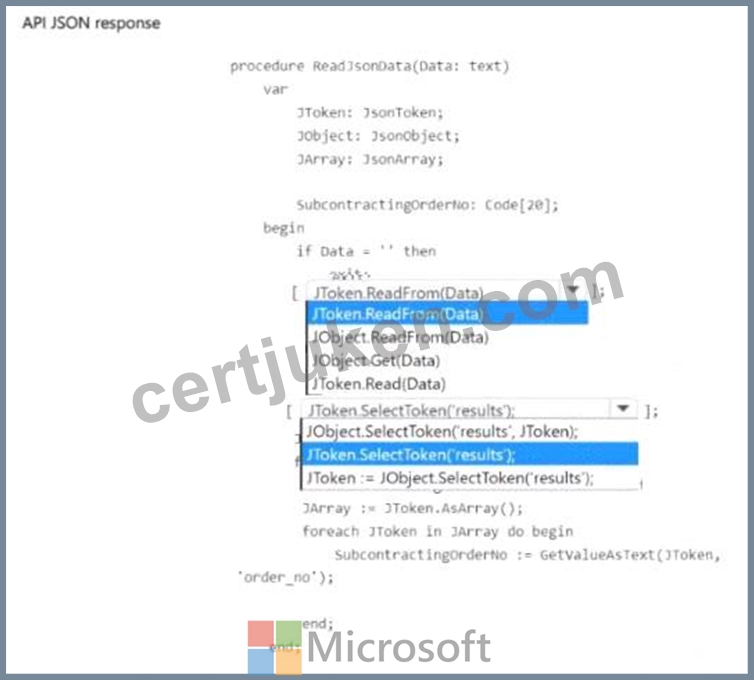
正解:
解説: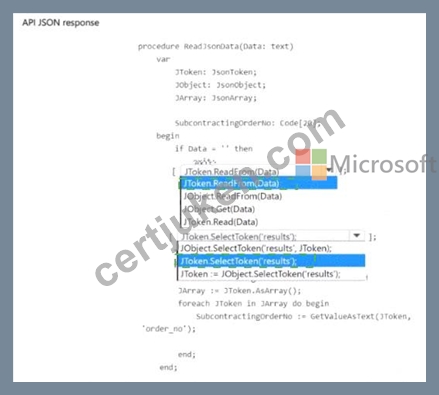
Explanation: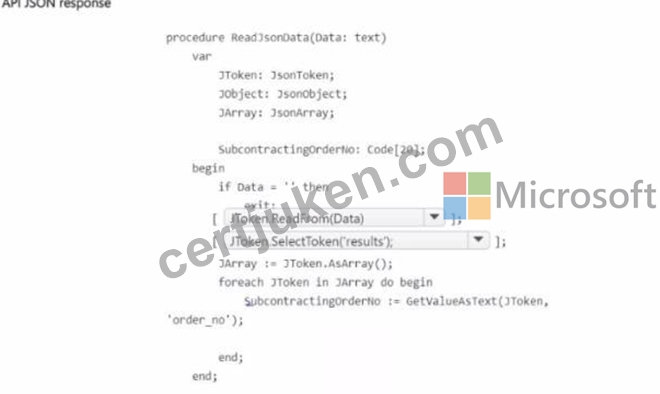
Code Segment Analysis:
* The AL code is trying to read JSON data from a response and process it to extract subcontracting order numbers. It uses JsonToken, JsonObject, and JsonArray to work with the JSON data.
* JToken.ReadFrom(Data): This line reads the incoming JSON data and converts it into a token. It processes the full JSON body so you can start working with it.
* JToken.SelectToken("results"): This line selects the part of the JSON containing the results array.
The key "results" is where the JSON response data is expected to be found.
* JsonArray: Once the results are extracted, they are stored as an array, and each element in the array (which is expected to contain subcontracting order numbers) is processed.
* SubcontractingOrderNo: The extracted order_no from the JSON is stored in this variable.
Breakdown of Steps:
* JToken.ReadFrom(Data): This step reads the entire JSON response.
* JToken.SelectToken("results"): This step selects the results array from the JSON response.
* JArray.AsArray(): This step converts the selected results token into a JSON array that can be iterated over.
* GetValueAsText(JToken, 'order_no'): This step retrieves the order_no from each element in the array.
Correct Code Completion:
* JToken.ReadFrom(Data): This is the correct method to read the incoming JSON response, as it will convert the string into a JsonToken that can be further processed.
* JToken.SelectToken("results"): This is the correct method to extract the results array from the token.
This method looks for the key "results" in the JSON and retrieves the relevant array.
Final Code Segment:
al
Copy code
procedure ReadJsonData(Data: text)
var
JToken: JsonToken;
JObject: JsonObject;
JArray: JsonArray;
SubcontractingOrderNo: Code[20];
begin
if Data = '' then
exit;
JToken := JToken.ReadFrom(Data); // Step 1: Read the JSON response data.
JToken := JToken.SelectToken('results'); // Step 2: Select the "results" array.
JArray := JToken.AsArray(); // Convert the token into a JSON array.
foreach JToken in JArray do begin
SubcontractingOrderNo := GetValueAsText(JToken, 'order_no'); // Retrieve the order number.
end;
end;
* JToken.ReadFrom(Data): This reads the raw JSON data string and converts it into a JSON token that can be processed.
* JToken.SelectToken("results"): This extracts the results array from the JSON data.
* JArray.AsArray(): Converts the token into an array so we can iterate over it.
* GetValueAsText(JToken, 'order_no'): Extracts the order_no value from each item in the array.
質問 # 91
......
MB-820模擬試験は、緊急の課題に対処するための最適な選択および有用なツールとなります。 10年以上の努力により、当社のMB-820トレーニング資料は、業界で最も広く称賛され、待望の製品になりました。革新メカニズムを近代化し、専門家の強力なプールを育成することにより、MB-820試験問題の3つのバージョンがあります。したがって、MB-820模擬テストの計画と設計において、プロのエリートからの完全な技術サポートをご安心ください。
MB-820最新知識: https://www.certjuken.com/MB-820-exam.html
- MB-820最新試験情報 ???? MB-820問題と解答 ???? MB-820試験関連情報 ???? ⮆ jp.fast2test.com ⮄の無料ダウンロード“ MB-820 ”ページが開きますMB-820復習範囲
- MB-820最新資料 ???? MB-820試験関連情報 ???? MB-820トレーニング費用 ???? 検索するだけで⮆ www.goshiken.com ⮄から( MB-820 )を無料でダウンロードMB-820最新資料
- MB-820問題と解答 ♣ MB-820受験準備 ???? MB-820無料試験 ???? ➡ www.jpshiken.com ️⬅️に移動し、⮆ MB-820 ⮄を検索して無料でダウンロードしてくださいMB-820日本語受験教科書
- 権威のあるMB-820全真模擬試験 - 合格スムーズMB-820最新知識 | 高品質なMB-820最新試験情報 ???? ▛ www.goshiken.com ▟を入力して[ MB-820 ]を検索し、無料でダウンロードしてくださいMB-820日本語試験対策
- MB-820試験の準備方法|ユニークなMB-820全真模擬試験試験|真実的なMicrosoft Dynamics 365 Business Central Developer最新知識 ???? ( www.japancert.com )サイトにて最新⇛ MB-820 ⇚問題集をダウンロードMB-820合格資料
- MB-820全真模擬試験 - 高品質 MB-820最新知識 試験Microsoft Dynamics 365 Business Central Developerを効率的に合格のを助ける ???? ( www.goshiken.com )を開いて➥ MB-820 ????を検索し、試験資料を無料でダウンロードしてくださいMB-820最新資料
- MB-820試験 ???? MB-820サンプル問題集 ???? MB-820最新関連参考書 ???? ▷ www.copyright.jp ◁から[ MB-820 ]を検索して、試験資料を無料でダウンロードしてくださいMB-820復習範囲
- 100%合格MB-820全真模擬試験と一番優秀なMB-820最新知識 ???? ➠ www.goshiken.com ????サイトにて《 MB-820 》問題集を無料で使おうMB-820資格トレーニング
- 権威のあるMB-820全真模擬試験 - 合格スムーズMB-820最新知識 | 高品質なMB-820最新試験情報 ???? ⇛ www.xhs1991.com ⇚を開いて▶ MB-820 ◀を検索し、試験資料を無料でダウンロードしてくださいMB-820トレーニング費用
- MB-820問題と解答 ???? MB-820無料試験 ???? MB-820受験準備 ⏹ URL ⮆ www.goshiken.com ⮄をコピーして開き、➽ MB-820 ????を検索して無料でダウンロードしてくださいMB-820テスト問題集
- 100%合格MB-820全真模擬試験と一番優秀なMB-820最新知識 ???? ( www.it-copyright.com )には無料の「 MB-820 」問題集がありますMB-820問題と解答
- graysoncekl294904.wikilentillas.com, www.stes.tyc.edu.tw, mayawuxq739233.bloggosite.com, 1001bookmarks.com, ragingbookmarks.com, katrinauppi834446.wikilentillas.com, leaogik091524.webbuzzfeed.com, oisiepau775986.thenerdsblog.com, keirangttr545739.blogofchange.com, www.thingstogetme.com, Disposable vapes
無料でクラウドストレージから最新のCertJuken MB-820 PDFダンプをダウンロードする:https://drive.google.com/open?id=1y87DurNvr_oMv78YEZynyVxZMxYS_mm-
Report this wiki page